OFFSHORE SYSTEM SPECIFICATION
How to Define LARS, DDC, ROV, and Diving Equipment for Reliability and Compliance
Offshore projects rarely fail because a single component breaks. They fail because systems are specified in isolation, integrated under schedule pressure, and then expected to perform reliably in environments defined by motion, limited access, and regulatory scrutiny. Launch and Recovery Systems (LARS), Deck Decompression Chambers (DDCs), ROV deployment systems, and commercial diving spreads sit at the center of this risk profile. These systems interface directly with vessels, personnel, subsea infrastructure, and statutory compliance requirements.

Offshore reliability is not achieved by selecting certified equipment alone. It is achieved when operating envelopes are clearly defined, interfaces are engineered deliberately, redundancy is functional rather than nominal, and systems are designed to remain controllable under degraded conditions. These outcomes are largely determined during specification, long before fabrication, mobilization, or offshore commissioning begins.
This article provides an engineering-led framework for specifying offshore handling, hyperbaric, ROV, and diving systems for long-term reliability and compliance. It establishes the systems philosophy that underpins the entire article series, from LARS and DDC architecture through to ROV operations, diving assurance, and lifecycle reliability.
Why Offshore Systems Fail: Environment, Integration, and Specification Gaps
The offshore environment imposes constraints that are easy to underestimate during early project phases. Vessel motion introduces dynamic loads that far exceed static assumptions. Deck space limitations force compact layouts and shared interfaces. Equipment must function across changing sea states, extended duty cycles, and restricted maintenance windows. At the same time, offshore systems are often expected to satisfy multiple regulatory regimes over a single lifecycle.

Many failures attributed to harsh offshore conditions are, in reality, specification failures. Undefined operating envelopes allow equipment to be used beyond design intent. Late interface definition forces offshore modifications that compromise performance. Redundancy that exists only on drawings fails to function during real fault conditions. Documentation gaps delay audits and recertification.
Specification is the stage at which these risks can be addressed systematically. The purpose of offshore system specification is not to maximize nominal performance, but to define constraints explicitly and engineer predictable behavior when conditions are least forgiving.
4 Engineering Factors That Control Offshore Performance
Dynamic Loads Define the Design Envelope Dynamic loads govern offshore performance far more than static ratings. Vessel motion, wave interaction, side loading, and splash-zone impacts introduce load cases that dominate real operations. For LARS, ROV handling, and diver deployment systems, dynamic amplification can exceed static loads by wide margins.
Specifications must define operating envelopes that account for sea state, wind, current, payload characteristics, and duty cycle. Systems specified only by static capacity leave unacceptable ambiguity once operations begin, forcing operational decisions into grey areas where risk increases rapidly. Undefined envelopes result in equipment operated beyond design intent, causing structural failures that were entirely predictable during specification.
Compliance Across Jurisdictions Requires Design Margin
Offshore assets are frequently redeployed between regions and projects. Equipment specified only to local minimum requirements becomes difficult to mobilize elsewhere. Design margin is not inefficiency offshore, it is what enables redeployment without repeated modification, recertification, or operational restriction.
Specification philosophies aligned with internationally recognized frameworks reduce friction during audits and inspections and allow equipment to transition between regulatory environments more predictably. Systems designed to the lowest common requirement face delays during cross-border audits and may require expensive modifications before new deployments.
Integration Failures Cause Downtime
Interfaces are the most common source of offshore failure. Foundations, hydraulic supply, electrical power, controls, and data connections must be engineered as part of the system, not treated as installation details. Incomplete interface definition leads to misalignment, control instability, and extended commissioning offshore.
Reliable offshore systems are those whose interfaces are fully defined before fabrication begins. Field modifications to correct interface gaps introduce unanalyzed load conditions, compromise documentation accuracy, and delay operations while engineering reviews are conducted remotely.
Maintainability Determines Uptime
Offshore reliability depends on inspection access, fault isolation, and the ability to replace components safely. Systems that require major disassembly or hazardous access for routine maintenance suffer extended downtime and increased personnel risk. Maintainability must be specified deliberately, not assumed.
Equipment designed without maintenance access provisions increases downtime and raises injury risk during offshore repairs. Components that fail within enclosed spaces or require lifting equipment for removal extend repair durations and may force operations to cease until conditions improve.
Specifying Launch and Recovery Systems for Offshore Conditions
Start With the Mission Profile
LARS specification must begin with a clear operational profile. Diver bells, ROVs, tooling packages, and mixed payloads impose fundamentally different load cases and control requirements. Water depth, vessel type, expected sea states, cycle rates, and recovery scenarios must be stated explicitly.
Generic specifications create systems that appear flexible but perform poorly under real operating conditions. Equipment rated for multiple applications without defined performance criteria in each introduces compromises that affect all operations. Specifications should address the most demanding use case and verify that less demanding applications remain supported.
Man-Riding and Subsea Handling Requirements
Man-riding applications require conservative redundancy philosophy, controlled braking, reliable load monitoring, and clearly defined emergency recovery modes. Redundancy must preserve control during faults, not simply duplicate components. Systems with shared hydraulic circuits feeding redundant brakes or common control logic for primary and secondary systems provide nominal redundancy that fails under real fault conditions.
For subsea handling, side loading, shock mitigation, and umbilical management are equally critical. Poor splash-zone control introduces damage that may not be immediately visible but degrades structural integrity and service life over time. Repeated shock loads during deployment accumulate fatigue damage that manifests as sudden structural failure after extended campaigns.
Interfaces That Must Be Engineered Early
LARS performance depends on foundation stiffness, deck load distribution, hydraulic power availability, and control integration. Specifications should require dynamic load data for foundation design, defined hydraulic demand throughout operating cycles, and operator interfaces that remain usable under stress.
Foundations designed only for static loads will deflect under dynamic conditions, introducing misalignment and accelerated wear. Hydraulic systems sized for nominal demand without margin for peak flow requirements or elevated ambient temperatures will overheat during extended operations. Control interfaces that function adequately during testing often prove inadequate offshore when operators must interpret system state while managing vessel motion and time pressure.
FAT and SAT as Proof of Behaviour
Factory and Site Acceptance Tests must verify behaviour across the defined operating envelope, including emergency and degraded modes. Tests limited to nominal conditions provide false confidence and leave critical failure paths unproven until offshore operations.
Acceptance testing should include fault injection to verify redundancy functions as intended, dynamic load scenarios that approximate offshore conditions, and operator interface validation under realistic stress and distraction. Tests that only confirm movement under ideal conditions miss the failure modes that govern offshore risk.
Deck Decompression Chamber Systems: Pressure Containment and Life-Support Architecture
The Role of Deck Decompression Chambers Offshore
Deck Decompression Chambers support surface decompression, treatment, and emergency response in commercial diving operations. While pressure containment is fundamental, offshore reliability is determined by life-support architecture, redundancy, and the ability to sustain controlled conditions over extended durations.
Chambers that meet pressure vessel requirements but lack robust life-support integration introduce unacceptable operational risk. Gas management, environmental control, and monitoring systems determine whether the chamber remains habitable during extended decompressions or emergency scenarios. Structural adequacy without life-support reliability provides no protection.
Pressure Vessel Integrity and Traceability
Pressure vessel compliance establishes structural safety, but offshore confidence depends on traceability. Specifications should require full material certification, weld records, pressure test documentation, and inspection access provisions.
Incomplete documentation frequently delays third-party inspection and regulatory approval during mobilization. Missing material traceability prevents recertification when projects cross jurisdictions or when periodic inspection intervals expire. Chambers without adequate documentation remain unavailable until records are reconstructed or re-testing is completed.
Life-Support as a System
Gas management, CO₂ scrubbing, environmental control, communications, and emergency modes must be engineered as an integrated system. Redundancy must remain functional under realistic fault scenarios, with clear operating procedures that can be executed by trained personnel under stress.
Single-point failures in life-support subsystems can force emergency decompression and compromise diver safety. CO₂ scrubbing systems without backup capacity or clear changeover procedures create scenarios where occupants must be decompressed prematurely when scrubber media becomes saturated. Environmental control failures that allow temperature or humidity to rise beyond physiological limits degrade occupant endurance and decision-making during critical periods.
Containerization and Mobilization Loads
Containerized DDC systems simplify transport but introduce additional load cases. Lifting, transport acceleration, deck securing, and access for maintenance must be addressed during design to avoid compromises during mobilization.
Inadequate mobilization design often results in damage during lifting operations and delays during vessel integration. Containers designed only for transport loads may not tolerate operational vibration or repeated lifting cycles during extended campaigns. Access provisions adequate for factory assembly often prove inadequate for offshore maintenance when personnel must work in restricted spaces with limited visibility and tool access.
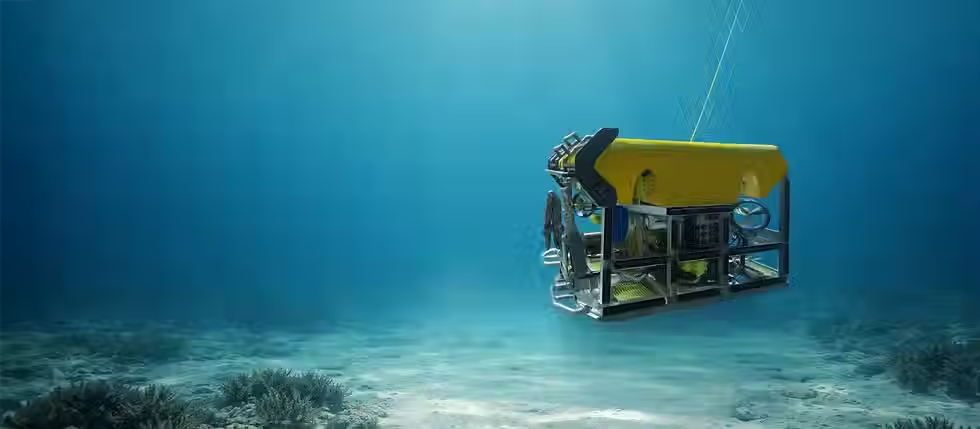
ROV Deployment Systems: Handling That Protects Assets and Data
Inspection Versus Intervention
Inspection ROVs prioritize stability and data quality, while intervention systems impose higher loads and tooling interfaces. Handling systems must be specified accordingly to support the maximum anticipated loads and control precision required for each application.
Systems designed only for inspection loads frequently fail under intervention duty cycles. Winches, sheaves, and umbilical management systems sized for lightweight inspection vehicles cannot tolerate the higher tensions, side loads, and tool reaction forces introduced by intervention operations. Specifying for inspection use with expectations of occasional intervention work creates equipment that performs neither role reliably.
Deployment Determines Data Quality
Launch stability, controlled descent, and repeatable recovery directly affect inspection and survey quality. Poor handling introduces vibration, cable stress, and sensor misalignment that degrade usable data.
Unstable deployment often leads to repeated dives, extended schedules, and increased exposure to operational risk. Survey data collected after unstable launch may meet technical specifications but prove unusable for analysis due to sensor drift or positioning errors. Inspection campaigns that require change detection or comparative analysis depend on deployment consistency to produce meaningful results.
Common Deployment Failure Modes
Water ingress, connector degradation, hydraulic contamination, and umbilical damage are common causes of ROV downtime. Deployment systems must provide strain relief, protective routing, monitoring, and maintenance access to prevent these failures.
Umbilical damage during handling remains one of the most costly offshore failures. Internal conductor damage from excessive bending or tension causes intermittent faults that are difficult to diagnose and expensive to repair. Umbilicals without adequate strain relief or bend radius control accumulate damage over repeated deployments until complete failure occurs, requiring cable replacement and extended downtime.
Commercial Diving Systems: Integration, Gas Quality, and Assurance
System Architecture and Integration
Commercial diving systems integrate gas panels, communications, hot water, monitoring, and emergency systems. Each subsystem must be sized for the operational profile and documented accordingly to support safe operations and regulatory compliance.
Poor integration directly limits productivity and safety. Systems with inadequate hot water capacity limit dive duration and reduce diver comfort, affecting task performance. Communications systems without backup channels or clear audio quality introduce confusion during critical operations. Monitoring systems that cannot provide real-time gas quality or diver status create blind spots that prevent supervisors from detecting developing problems.
Gas Quality and Compression
Breathing gas quality depends on compressor selection, filtration, monitoring, and maintenance. Specifications must define quality thresholds, alarm setpoints, and service intervals to prevent contamination.
Gas contamination is an immediate safety risk and a guaranteed cause of operational shutdown. Compressors without adequate filtration or operating in elevated ambient temperatures produce oil vapor that saturates filters prematurely and degrades air quality. Monitoring systems without continuous carbon monoxide detection leave gaps where contamination goes undetected until divers report symptoms. Poor gas quality discovered during operations forces immediate shutdown and extended investigation to identify root causes and verify corrective actions.
Audit Readiness and Documentation
Well-specified systems reduce audit friction by ensuring documentation, test records, and operating procedures are complete and traceable. Audit readiness is a design outcome, not an administrative exercise conducted before inspections.
Systems without configuration control or clear subsystem boundaries introduce uncertainty that auditors cannot resolve through inspection alone. Missing interface definitions prevent verification that the system operates within intended limits. Undocumented modifications accumulate discrepancies between records and physical configuration that delay approvals and require expensive remediation during mobilization.
Offshore Specification Is Governed by a Dual Framework
Offshore system specification operates within a dual framework that must be addressed explicitly to achieve both operational reliability and regulatory compliance.
Industry bodies such as the International Marine Contractors Association (IMCA), the Association of Diving Contractors International (ADCI), and NORSOK provide operational guidance, QHSE expectations, and industry best practice. These frameworks define how systems are intended to be used, managed, and maintained safely in real offshore conditions.
In parallel, statutory compliance is defined through the International Maritime Organization (IMO) and implemented through classification societies that are members of the International Association of Classification Societies (IACS). This layer governs construction standards, structural integrity, pressure vessels, lifting appliances, and certification required for installation on vessels and offshore structures.
Reliable offshore systems must satisfy both layers simultaneously. Operational guidance ensures equipment is fit for purpose, while statutory and classification compliance ensures it can be legally certified, installed, and operated. Treating either framework in isolation introduces avoidable risk, delays, and rework during mobilization and audit phases. Systems that meet classification requirements but ignore operational guidance prove difficult to use safely. Systems that align with operational best practice but lack proper certification cannot be deployed.
Design and Specification Considerations
Engineers preparing RFQs or technical specifications should ensure the following are clearly defined to prevent offshore failures:
Operating envelope and environmental limits - undefined limits result in equipment operated beyond design intent, causing premature failure and unplanned downtime
Rated loads, dynamic factors, and duty cycles - static load calculations without dynamic amplification lead to structural overload and accelerated fatigue
Redundancy and emergency recovery philosophy - single-point failures in critical systems leave no fallback during equipment faults or degraded conditions
Interfaces with vessel systems and deck structures - undocumented interfaces cause field modifications, extended commissioning, and unanalyzed load conditions
FAT and SAT requirements tied to real operating conditions - tests that skip operational scenarios and emergency modes leave failure modes undiscovered until offshore use
Documentation and traceability expectations - missing records delay audits, prevent equipment recertification, and complicate troubleshooting during operations
Maintenance access and spares strategy - poor access increases repair time, raises injury risk during offshore maintenance, and extends equipment downtime
Training and operating procedure requirements - inadequate operator training increases the likelihood of misuse, equipment damage, and unsafe practices
These elements form the foundation of offshore reliability. When omitted, they become the root cause of delays, rework, and unplanned downtime that erode project economics and compromise safety.
Practical Takeaways for Engineers and Project Teams
Define operating envelopes with explicit environmental limits and duty cycles to prevent operation beyond design intent
Size interfaces and foundations for dynamic loads including vessel motion and splash-zone impacts, not static calculations alone
Require functional redundancy in man-riding and life-support systems that preserves control during faults, not component duplication without failure analysis
Specify FAT and SAT protocols that test emergency modes, alarms, and operational limits under realistic conditions including fault injection
Demand full material traceability and testing documentation to support audits, cross-border mobilization, and periodic recertification
Design maintenance access into layouts during specification as an engineering requirement, not as an afterthought during installation
Reference international consensus standards and operational guidance to simplify compliance across jurisdictions and reduce rework during redeployment
Treat documentation and configuration control as system requirements that enable audit readiness and long-term supportability
Reliability Is an Engineering Outcome, Not a Label
Offshore systems do not become reliable because they are certified or labeled compliant. They become reliable when operating limits are explicit, interfaces are engineered deliberately, and systems remain controllable under degraded conditions.
When LARS, Deck Decompression Chambers, ROV deployment systems, and diving equipment are specified as parts of a single operational system, offshore projects gain predictability and resilience. That systems-level discipline is the foundation on which the rest of this article series builds, from operating envelope definition and redundancy philosophy through life-support architecture, deployment engineering, and lifecycle reliability management.

Comments